


On July 14, 2026, the Centers for Medicare and Medicaid Services issued a proposed rule that its own press release describes as transformational, and which Administrator Mehmet Oz characterized as among the most significant Medicare reforms in recent years.1 The word the agency chose for what it intends to do to physician payment is “modernize.” It is worth pausing on that word before going any further, because it is doing an enormous amount of work. Modernization implies that an outdated arrangement is being brought into alignment with present conditions. What the rule actually proposes is that physicians be paid less, that they be paid less through a mechanism that will make care slower and more expensive for patients, and that they file more paperwork to document the process. This is the fifth consecutive year in which the agency has arrived at the same destination by a different road, and the accumulated effect is no longer plausibly described as refinement.
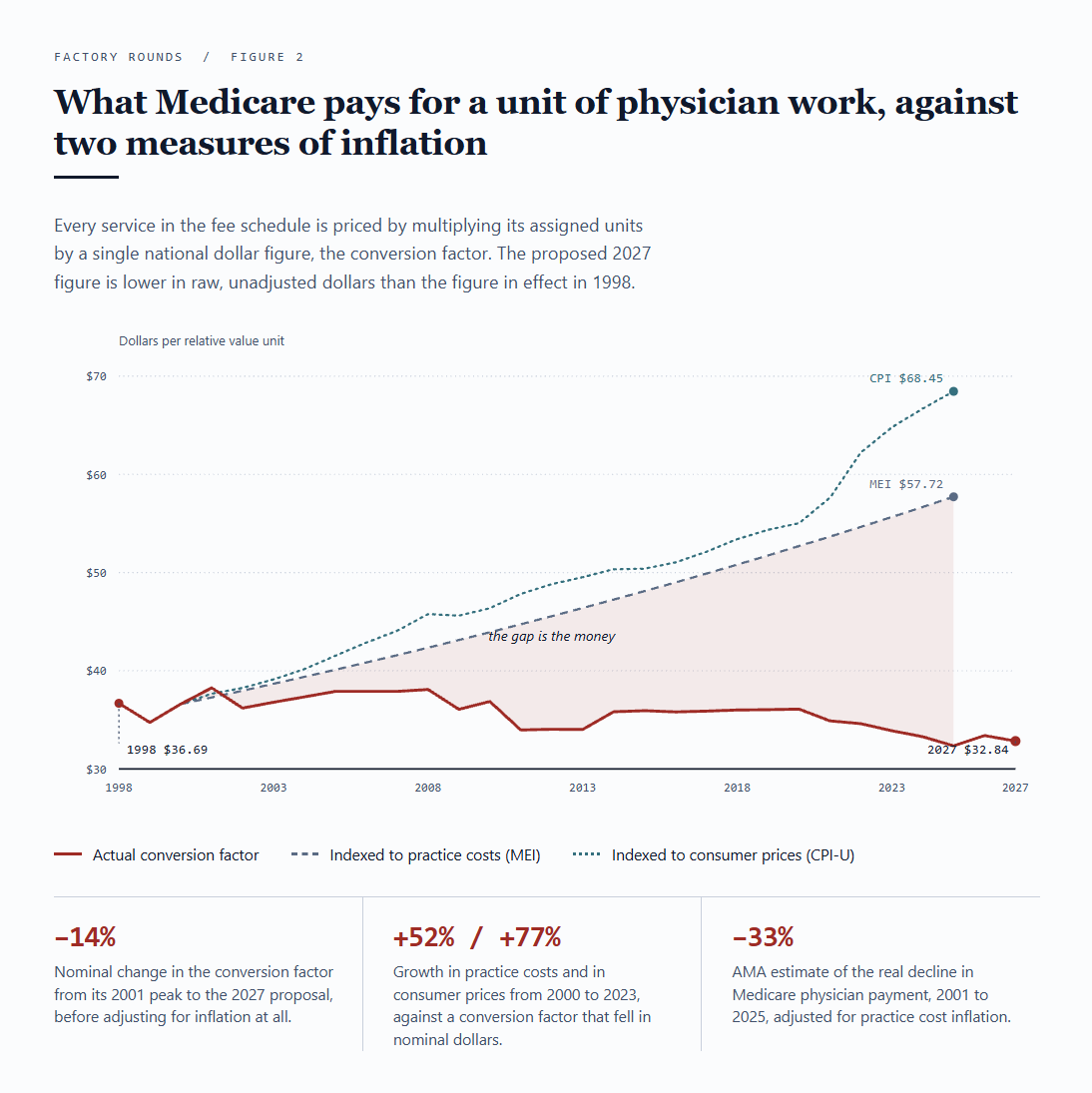
Some background is necessary here, because Medicare’s method of paying physicians is unfamiliar even to people who have been its beneficiaries for years. Medicare does not negotiate with doctors. It sets the price of every service in medicine by formula, published each year in a document called the Physician Fee Schedule. Each of roughly ten thousand billable services carries a numerical score meant to capture three separate things: the physician’s own labor and judgment, the overhead required to deliver the service, and the cost of malpractice coverage. That score is then multiplied by a single dollar figure called the conversion factor, which is the same for every service and every specialty in the country. The consequence of building a system this way is that a small adjustment to any one component moves thousands of prices at once. A further constraint compounds it. By statute the schedule must be budget neutral, meaning that any increase in what one service is worth has to be paid for by reductions in what others are worth. At no point does a patient’s willingness to pay or a physician’s willingness to accept enter the calculation. The price is set by committee and revised by rule, and the only question each year is which direction the rule moves it. In real terms, that direction has been remarkably consistent year after year for over 25 years: down.
The particulars of this year’s rule are worth setting out plainly, because the arithmetic gets buried quickly. For calendar year 2027, CMS proposes conversion factors of $33.17 for physicians who qualify as participants in advanced alternative payment models and $32.84 for everyone else, representing reductions of 1.19 percent and 1.68 percent respectively from the 2026 figures.2 Because that figure touches every service, a reduction in it is a reduction in the price of everything a physician does.
This follows a year in which two other changes were finalized and took effect on January 1, 2026. The first is what CMS calls an efficiency adjustment, a 2.5 percent reduction applied to two of the inputs described above, the units representing the physician’s own labor and the agency’s estimate of how long the service takes to perform, for all services that are not billed by time.3 That category is essentially every procedure, every imaging study, and every diagnostic test. The agency’s justification is that the survey data underlying its time estimates suffers from low response rates and from the conflicts of interest inherent in asking physicians how long their own work takes, and that the resulting figures are therefore probably inflated.
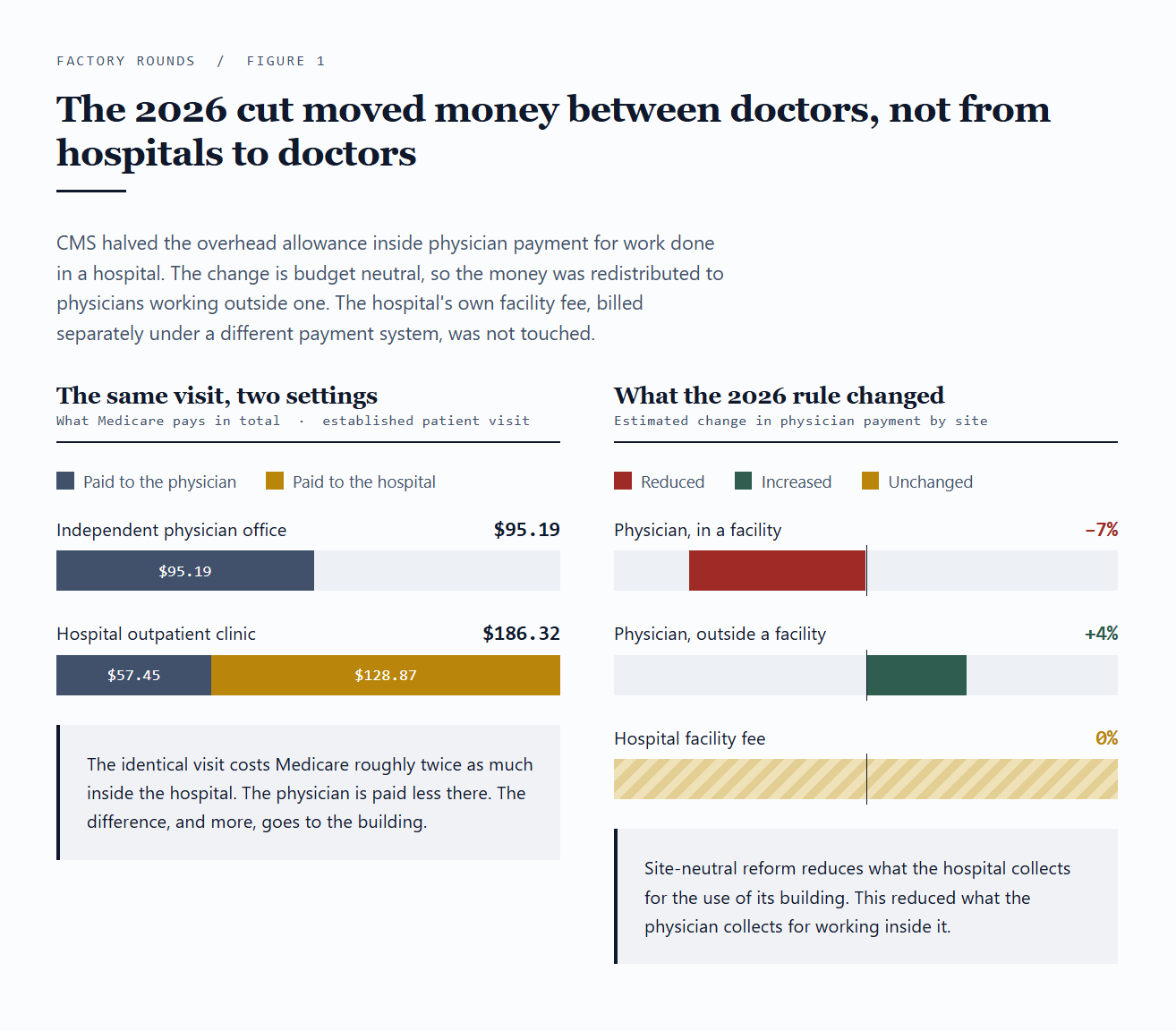
The second change is more easily misunderstood, and it requires a word about how a hospital gets paid. When a physician performs a service in his own office, Medicare makes one payment, meant to cover both his professional work and the overhead of the room he works in. When the identical service is performed inside a hospital, Medicare makes two payments: a smaller professional fee to the physician, on the theory that he is not the one paying for the room, and a separate facility fee to the hospital under an entirely different payment system with its own annual rule. The professional fee has always been lower in the hospital. The combined total has almost always been higher, and frequently by a great deal. Medicare pays on the order of two to four times more for many identical outpatient procedures performed in a hospital outpatient department than in an independent physician’s office.4
What CMS finalized for 2026 does not touch the facility fee. It cuts the physician’s portion. The agency halved the overhead allowance built into professional payment for services delivered in a facility setting, reasoning that so few physicians now maintain private offices that the old assumption no longer describes how medicine is practiced.5 Because the change is budget neutral, the savings do not return to the Treasury. They are redistributed to physicians working outside hospitals. The American Medical Association calculates the resulting shift at roughly seven percent downward for services performed in facilities and four percent upward for services performed outside them.6 CMS titled this provision a site of service payment differential, which invites the reader to hear site-neutral reform. It is closer to the opposite. Genuine site neutrality reduces what the hospital collects for the use of its building. This reduces what the physician collects for working inside it, and leaves the building’s fee precisely where it was. The money moved from hospital-based physicians to office-based physicians. It did not move from hospitals to physicians.
There is a circularity in the justification. CMS reasons that facility-based physicians no longer require an overhead allowance because so few physicians remain in independent practice. That is accurate as a description of the present. It is also a condition that the payment system produced, in no small part through the very facility fee differential that allowed hospitals to outbid independent practices for identical work. The agency is citing the consequence of its own pricing as grounds for a further reduction. And the reduction falls with particular force where no alternative setting exists. An emergency physician has no non-facility option available to him. The emergency department is a facility by definition, so he absorbs the seven percent and can never reach the four.
Layered on top of the payment changes is an expansion of regulatory obligation. Traditional participation in the Merit-based Incentive Payment System is to be phased out in favor of mandatory Merit-based Incentive Payment System Value Pathways, with the older system sunset by 2029.7 Separately, CMS has already launched the WISeR model, a six-year demonstration that introduced machine-assisted prior authorization and prepayment review into traditional Medicare beginning in January of this year across six states.8 Participation is nominally voluntary, but physicians who decline to seek prior authorization are subjected to automatic prepayment review instead, which is a distinction without much practical difference. Medicare beneficiaries have historically been spared the prior authorization apparatus that governs commercial coverage. That exemption is now ending, and it is ending under an administration that campaigned against prior authorization as a commercial abuse.
All of this sits on a longer trend. The American Medical Association, working from Federal Register data, Medicare Trustees reports, and federal inflation statistics, calculates that Medicare physician payment declined 33 percent in real terms between 2001 and 2025 once the inflation in practice costs is accounted for.9 Physician services remain the only major category of Medicare spending not indexed to inflation. Hospitals receive an annual update tied to their input costs. Ambulatory surgical centers receive one. Medicare Advantage plans receive one. Physicians receive a statutory 0.25 or 0.75 percent, and then whatever the budget neutrality calculations do to them afterward.
That figure deserves a qualification its partisans rarely supply. MedPAC, examining the same stretch of years, confirmed the gap: the conversion factor stood at $36.61 in 2000 and $33.89 in 2023, a decline in unadjusted dollars, while the index of practice costs rose about 52 percent over the same years.10 But the same MedPAC analysis found that Medicare spending per beneficiary on fee schedule services grew roughly 101 percent over those years, because the volume and intensity of services climbed even as the price of each one fell. Total spending on physician services did not decline. It approximately doubled. Anyone who cites the inflation-adjusted figure without saying so is presenting half a ledger.
The qualification matters, though not in the direction its usual proponents intend. A payment system that holds down the price of every unit while the number of units rises is not a system that has treated physicians generously. It is a system that has quietly instructed them to work faster in order to stand still, and they have complied, which is the reason aggregate spending rose at all. That is the treadmill. The rule now under consideration adds another revolution to it.
The provision that deserves the most attention, however, is not the conversion factor. It is a proposal CMS describes as accounting for overlap between stand-alone evaluation and management visits and global periods. Two pieces of vocabulary are required to follow it. An evaluation and management visit is the thinking part of an encounter, the portion in which the physician takes a history, examines the patient, and works out what is wrong. A global period is a window of time following a procedure, ranging from zero to ninety days depending on the procedure, during which any related follow-up care is treated as already bought and paid for by the original fee.
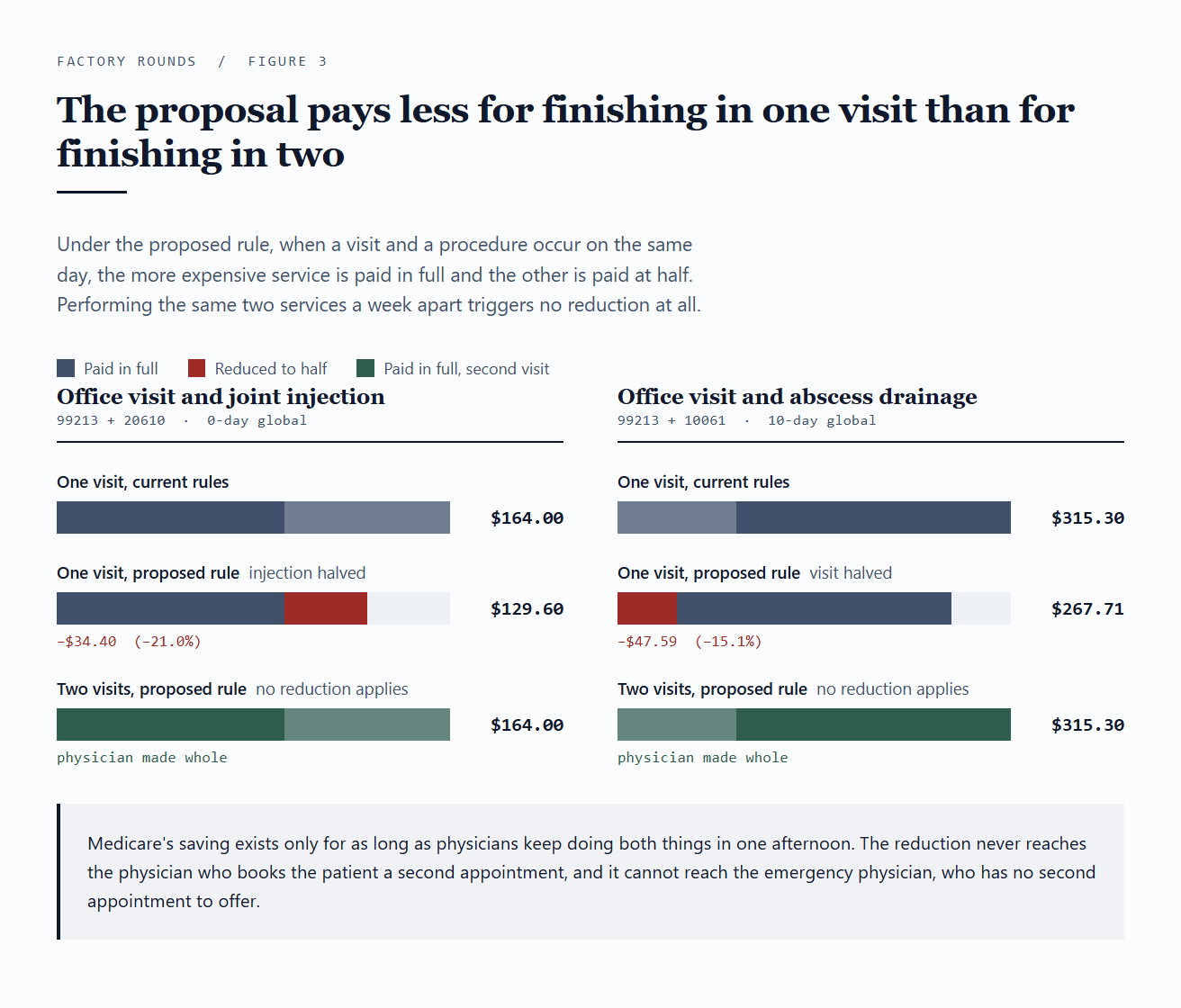
Under the proposal, when a physician performs a distinct office or outpatient visit on the same day as a procedure carrying such a period, the most expensive of the services is paid in full and every other service furnished that day is paid at half rate.11 In plainer language, a physician who sees a patient in the office, determines that he needs a procedure, and performs it that same day will only be paid half the price of either the procedure or the evaluation. The agency’s reasoning is that when the same physician evaluates a patient and then performs a procedure on that patient in the same encounter, some of the work is shared, and paying separately for both therefore compensates the physician twice for a single effort. CMS proposed something similar in 2019 and did not finalize it. It has now returned.
The observation underlying the proposal is not false. There is overlap. A physician who examines a shoulder and then injects it has not conducted two independent examinations, and the history he takes serves both purposes at once. Anyone who has watched the modifier that designates a separately identifiable visit be applied with enthusiasm knows the agency’s concern was not manufactured out of nothing. If some physicians bill dishonestly, though, that is an argument for enforcing the rules against those physicians. It is not an argument for repricing the work of the ones who don’t. And notice what the agency does with its observation. It reasons that because less work went into the second service, the second service is worth less, and it then proceeds to calculate how much less. That inference is the whole of the policy, and it is mistaken at the root.
The price of a thing is not determined by the effort poured into it. The contrary belief, that a good’s worth derives from the labor embodied in it, is the Labor Theory of Value, and it was among the more consequential errors of nineteenth century economics. It was answered in the 1870s by Carl Menger and the school that grew up around him. Value is not a property residing inside an object or a service, waiting to be recovered by an auditor with a stopwatch. It is a judgment, made by the person who wants the thing, about what having it is worth to him. Ludwig von Mises stated the matter about as plainly as it can be stated: value “is not intrinsic, it is not in things.”12 A shirt sold under a luxury label and a shirt sold by a discount retailer may be cut from the same cloth in the same factory by the same hands, and they will never command the same price, because a price does not report the conditions of manufacture. It reports what someone will pay.
The rest of the economy conducts itself accordingly. A mechanic who replaces the brakes and the alternator in one appointment does not bill half for the second repair on the grounds that the car was already on the lift. A barber who cuts a man’s hair and colors it in the same sitting does not charge half for the cut. It is fair to object that a mechanic sometimes will discount the second repair, and that salons sell packages priced below the sum of their parts, and the objection deserves an answer rather than a dismissal. The answer is that such a discount is offered, not imposed. It emerges from a negotiation between a seller who knows his own costs and a buyer who knows what the work is worth to him, and it comes to rest wherever the two of them consent. Nobody computes it, and nobody else is bound by it. What CMS proposes is not a discount but a finding: an official determination, binding on every physician in the country, that the second service is worth exactly half. A negotiated price and a calculated one are not the same kind of thing, and the difference between them is not one of degree.
This is why the particular figure is nearly beside the point, though it is worth noting that fifty percent is not a measurement of anything. It is a round number. No study established that the shared work between an evaluation and a procedure amounts to half the value of the lesser service, and no study could, because the sharing differs in every pairing the rule would govern. The overlap between an office visit and a skin biopsy is not the overlap between an office visit and a complex wound repair. But a perfectly measured figure would not rescue the policy either, because the measurement answers a question that has nothing to do with price. Every instrument in the fee schedule is an instrument for measuring inputs. Work units measure time and intensity. The efficiency adjustment measures assumed productivity. This provision measures assumed duplication. Nowhere does the apparatus ask what the service is worth to the person receiving it, and it cannot ask, because that person is not paying for it and is not permitted to decline it at the stated price. There is nobody in the transaction whose refusal would mean anything.
It is telling that the agency justifies its efficiency adjustment by declaring its own time data unreliable, and then, having discredited its measurements, responds not by measuring more carefully but by applying a different unmeasured number in the opposite direction. If the inputs cannot be trusted, the remedy is not a more confident guess about the inputs. The deeper trouble is that the inputs were never the thing worth looking at. A payer able to observe prices would have no need to compute them.
The consequence in outpatient practice is entirely foreseeable, and it is the opposite of what the rule intends. Consider a physician who sees a patient for a new complaint, determines that a procedure is warranted, and can perform it that afternoon. Under current payment he does so. Under the proposed rule, performing it that afternoon costs him half the value of one of the two services. Deferring the procedure to a separate appointment costs him nothing. He is not required to defer, and the vast majority of physicians will not defer where deferral would harm the patient. But most of these procedures are not urgent, deferral is clinically defensible in the ordinary case, and the physician who schedules a return visit can give an entirely honest account of why he did so. He wants to think it over. He wants the patient to consider the options. The schedule that day was full. Every one of those statements can be true, and the payment rule will have made all of them more likely to be uttered.
This is not an accusation of fraud but merely a description of how prices work. Prices communicate information to sellers. A price that penalizes doing two things at once will produce fewer instances of doing two things at once. The physician responding to that signal is doing what the payer’s own price structure instructs him to do. The result is that the patient who could have been finished in one afternoon now makes two trips, pays two facility fees or two copayments, takes a second day away from work, arranges a second ride if he does not drive, and waits however long the schedule requires with his problem unresolved. Medicare pays for two encounters where it previously paid for one and a half. A rule adopted to eliminate duplicative payment will have manufactured genuine duplication, and will have charged the beneficiary for the privilege in money, time, and delay.
The agency has precedent to consult on this point and appears not to have consulted it. Medicare has applied multiple procedure payment reductions to diagnostic imaging and to therapy services for years, reducing payment for second and subsequent services performed in the same session on the same theory of shared resources.13 Those policies generated persistent disputes about whether the assumed efficiencies were ever demonstrated, and they taught the professions subject to them to think carefully about what gets scheduled on which day. The lesson available from that history is that same-session reductions do not reduce the amount of care delivered. They redistribute it across the calendar.
As the proposed rule is literally written, the fifty percent reduction is triggered by office and outpatient evaluation and management codes. Emergency department visit codes belong to a different family and are not captured by the text as drafted, and the American College of Emergency Physicians did not identify this provision among its principal concerns in its summary of the rule. An emergency physician reading a headline about a fifty percent cut and concluding that his own billing is affected on January 1, 2027 has read too quickly.
He has not, however, read wrongly about where this is going. CMS explicitly solicits comment on whether the policy should be extended to other categories of evaluation and management visits.14 That solicitation is how these provisions arrive: proposed narrowly, finalized narrowly, and then extended in a subsequent cycle once the principle has been established and the affected specialty has already absorbed the first version. More to the point, the rationale CMS offers contains nothing that stops at the clinic door. If the overlap between an evaluation and a procedure performed in the same encounter justifies halving payment for the lesser service, that argument applies with greater force in the emergency department, not less, because in emergency medicine the evaluation and the procedure are always the same encounter by necessity. The agency has articulated a principle whose logic points directly at the setting where the conduct it describes is universal and unavoidable.
And the emergency department has no answer to it. The clinic’s response to this rule is the calendar. The emergency department has no calendar. A laceration is closed during the visit in which it presents. A shoulder is reduced when the patient arrives with it dislocated. An abscess is drained then, a chest tube placed then, a fracture splinted then. There is no version of emergency practice in which the physician evaluates a patient, identifies a procedure, and offers him an appointment. The federal government has made certain of this, having required by statute since 1986 that emergency departments evaluate and stabilize every patient who presents regardless of ability to pay.15 The same government that mandates the immediacy would, under an expansion of this policy, reduce payment for the immediacy on the theory that it represents an efficiency the physician chose to capture.
It is worth being precise about who bears that. Emergency medicine already operates on an unusual economic footing. CMS itself has historically assumed that a majority of an emergency physician’s time is uncompensated, a consequence of the obligation to treat everyone who arrives regardless of ability to pay.16 Burnout in the specialty has been measured at levels at or near the highest of any field of medicine, and the drivers identified in the literature are not the acuity of the work but the conditions surrounding it.17 The residency match in emergency medicine collapsed in 2023, when more than five hundred positions went unfilled, recovered substantially, and remains volatile in a way it was not a decade ago.18 Boarding, the practice of holding admitted patients in the emergency department because no inpatient bed is available, has been declared a crisis by essentially every organization in a position to declare one, and it converts an emergency department into an unstaffed inpatient ward while new patients continue to arrive.
Into that, add the practice expense reduction already finalized for facility settings, which the American College of Emergency Physicians objected to specifically on the ground that it misunderstands how emergency care is actually delivered.19 Then add a conversion factor cut. Then add, prospectively, a halving of payment for procedures the physician had no option to defer. The department that is already the least able to absorb a reduction is the department positioned to absorb the largest one.
The downstream mechanism is where the real damage lies, and it runs through hospital accounting rather than through physician income. Emergency departments are treated in most hospital budgets as cost centers. They consume space, staffing, and equipment, and the professional revenue they generate rarely covers what they consume. This accounting is not merely conservative. It is wrong, and demonstrably so. RAND’s study of the evolving role of emergency departments found that emergency physicians serve as the principal decision makers for roughly half of all hospital admissions in the United States.20 The emergency department is the mechanism through which the hospital acquires the inpatients on whom its margins depend. But the revenue from those admissions is booked to the inpatient service lines, while the cost of generating them is booked to the emergency department. The department that produces the hospital’s business appears on the ledger as an expense.
An administrator looking at that ledger in a year when emergency professional revenue declines does not see a specialty in distress. He sees a cost center performing worse than last year, and he responds as he has been trained to respond. Nursing ratios are adjusted. Scribes are eliminated. Technicians are not replaced when they leave. The physician group’s contract is renegotiated downward or put out to bid, and the bid is won by whoever will staff it for less. Every one of those measures slows the department down. A slower department boards longer, sees fewer patients per hour, and generates less revenue, which produces a worse number on the next year’s ledger and another round of the same reasoning. This is what happens when a budget process treats a revenue-generating function as a cost and then reduces the revenue.
A fair objection is that sophisticated health systems understand the downstream contribution of emergency volume perfectly well and model it deliberately, and some of them do. But budget authority follows the cost center, not the model, and the marginal decision about staffing an emergency department is rarely made by the person holding the systemwide analysis. Another fair objection is that emergency physicians are hospital-based and largely employed, so the professional fee schedule matters less to them personally than to an independent surgeon. That is true of the individual paycheck and irrelevant to the argument. The professional revenue still determines what the department is worth to the institution, and the institution is what determines whether there are enough people working on a Tuesday night.
The administrative burden compounds all of it. Physician practices in four common specialties were found to spend an average of 785 hours per physician each year on the reporting of quality measures, at an aggregate cost exceeding $15.4 billion.21 That study is now a decade old, and the reporting obligations it measured have not contracted. The rule under discussion adds a mandatory pathway structure and arrives alongside a prior authorization demonstration in traditional Medicare. Each of these is defended individually as a modest addition. Collectively they constitute a second occupation practiced alongside the first, and they are the principal reason independent practice has become difficult to sustain. The share of American physicians employed by hospitals or corporate entities rose from roughly a quarter in 2012 to more than three quarters by 2024.22 That is the actual downstream effect of twenty-five years of payment policy, and it is worth stating clearly what it costs. The independent practice is the exit option. It is the thing a physician can do when the terms offered become unacceptable. A profession without an exit option does not negotiate. It receives.
The curious task of economics is to demonstrate to men how little they really know about what they imagine they can design.23
-F.A. Hayek
The deeper problem is not that CMS chose the wrong number. It is that a single number was going to be chosen at all. The agency is attempting to set thousands of prices for hundreds of millions of encounters occurring under conditions it cannot observe, using survey data it has publicly declared unreliable, subject to a budget neutrality requirement that makes every increase somewhere a decrease somewhere else. The arrangement is working exactly as an arrangement of that kind must.
Prices in a market are not measurements taken by an observer; they are the output of countless people revealing what they will actually pay and actually accept. Remove the paying and the accepting, and no amount of methodological care recovers the information, because the information was never sitting somewhere waiting to be gathered. It is generated by the transaction or it does not exist. The physician who has spent two decades watching his reimbursement fall while his costs rise is not the victim of a miscalculation. He is watching a system that has no mechanism for discovering that it is wrong. Keith Smith, who founded a surgical facility in Oklahoma that has posted its all-inclusive prices publicly since 2009 and accepts no insurance, has put the point more economically than I can: imposed prices are always wrong.24 Too high or too low, but never accurate, because accuracy is not a property that administered prices are capable of having.
Budget neutrality makes the pathology explicit. Because every increase must be offset, the specialties do not compete to attract patients. They compete against one another for shares of a fixed pool, in front of the same committee, with the same lobbyists. Cardiology’s gain is oncology’s loss by regulatory arithmetic rather than by anything either of them did for a patient. A system that pitted grocers against one another this way, holding total grocery revenue fixed and adjudicating the split annually in Washington, would be recognized immediately as absurd.
I should be candid about where I stand. I think Medicare should not exist. I think the same of Medicaid, and of most of the regulatory apparatus assembled around them, and my objection is not primarily a fiscal one. It has to do with what it means to compel a man into an arrangement across the whole of his working life and then set the terms of his participation by rule, revised annually, with his only recourse a comment period. That is the subject of another essay and a longer one, and I will not pretend to have made the case here.
I raise it only in order to set it aside, because the reform I want to argue for requires no one to accept any part of it. Take Medicare exactly as it stands, funded as it is and universal as it is, and one change remains available that needs no new program, no appropriation, and no act of political imagination. It needs the repeal of a restriction. Under current law, a physician who wishes to contract privately with a Medicare beneficiary at a mutually agreed price must opt out of Medicare entirely for two years, forgoing all Medicare payment for all of his patients, and even then may not use a private contract for emergency or urgent care.25 This is not a public program with a private market alongside it. It is a toll gate with a single setting. A physician may not accept Medicare for most of his practice and contract privately for part of it. He may not charge a beneficiary who would gladly pay more for more of his time. The restriction has been criticized across the political spectrum as an unusual constraint on ordinary freedom of contract, imposed on a program whose participants were enrolled by the arrival of a birthday.26 Permit a beneficiary to carry a defined contribution to a physician of his choosing, at a price the two of them set between themselves, and you have created for the first time in sixty years a mechanism by which Medicare might discover what its services are actually worth.
Anyone inclined to hear in this a proposal that the elderly be left to fend for themselves should notice what is actually being asked for. Nothing is taken from the beneficiary. He keeps the benefit he has. What he gains is a permission he currently lacks, which is the right to spend his own money on a physician willing to treat him at a price the two of them agree upon. The objection assumes that the arrangement he has now is working, and this essay has spent some length explaining why the physicians on the other side of it are leaving.
That such arrangements function is not a matter of theory. Direct primary care practices publish their monthly fees and patients pay them. The Surgery Center of Oklahoma has posted its surgical prices for more than fifteen years, accepts no insurance, and draws patients from across the country who travel past hospitals nearer to home.27 These are not marginal curiosities. They are demonstrations that when a physician is free to name a price and a patient is free to refuse it, the price becomes knowable in advance, tends downward under competition, and requires none of the apparatus that consumes 785 hours of a practice’s year.
The strongest objection to all of this is that emergency care is not shoppable. The patient having a stroke does not compare prices. The unconscious patient consents to nothing and negotiates nothing. Information asymmetry, which is a manageable problem when a patient is choosing a knee replacement over several weeks, is total when he arrives by ambulance. Whatever a market can accomplish in elective surgery, it cannot be relied upon to set the price of resuscitation, so the argument goes.
This objection is generally correct about the case it describes, but it is worth noticing how small that case is. Roughly eighteen percent of emergency department visits arrive by ambulance. The other four fifths arrive by private vehicle, which is to say that the patient, or somebody sitting beside him, decided which hospital to drive to.28 When the National Center for Health Statistics studied how far patients travel to reach an emergency department, it excluded ambulance arrivals from the analysis on the express ground that those patients likely had little or no choice of which department they visited, which is a federal statistical agency stating plainly that the remainder do.29 Nor is the ambulance itself free of judgment. Crews weigh distance against capability, whether the receiving hospital has a catheterization laboratory or a stroke center or a trauma designation at the necessary level. They weigh what the patient says he wants. And they weigh, whether or not anyone says it aloud, which departments take the handoff promptly and treat the crew as colleagues and which leave them holding a stretcher against a hallway wall for the better part of an hour. Emergency departments compete already. They compete on capability, on reputation, on how the waiting room looks at nine in the evening, and on how they treat the people who bring them patients.
The insurance arrangements built on top of this give the game away. Insurers maintain networks for emergency care and negotiate rates for inclusion in them, and hospitals accept discounted rates in exchange for being included. That trade makes sense only if membership brings patients through the door, which is to say only if patients choose. Congress limited the consequences of the practice in 2021, barring balance billing for emergency services and capping what a patient owes at the in-network amount, and it did so on the stated ground that a patient in an emergency often cannot select his provider.30 But it did not abolish the networks. It moved the argument over the rate from the patient to an arbitration process, and hospitals go on paying in discounted rates for the privilege of appearing on the list. The industry’s own conduct, sustained across decades and continuing today, reflects a settled commercial belief that where a man goes for emergency care is a decision he makes. Emergency medicine is less shoppable than a knee replacement, but it is a good deal more shoppable than the objection allows.
The objection establishes that the emergency department is a poor site for price competition at the moment of a true, incapacitating medical or surgical emergency. It does not establish that administered pricing is therefore the right way to pay for it, and the evidence of the last twenty-five years is that administered pricing has served emergency medicine catastrophically.
Two responses follow, and the first requires some care, because a reader who has come this far will have noticed a tension. I do not think Congress should have written EMTALA. A statute that commands a private party to render a service and says nothing about paying him for it is a conscription, and describing the service as a right does not alter what has been done to the man obliged to provide it. The duty to treat a person who is dying in front of you is real, and it is a great deal older than the statute. Physicians and hospitals attended to emergencies before 1986 out of professional obligation and ordinary decency, and they would continue to do so without a federal command. The honest objection to that view is that they did not always do so, that patients were in fact turned away from emergency rooms for want of insurance, and that this is precisely why the law was written. I take the objection seriously. My answer is that the remedy chosen was worse than the disease, and that a mandate without money has produced a slower and more widely distributed version of the same abandonment, borne now by everyone sitting in the waiting room.
The statute exists, however, and it will not be repealed this year or next, and a position with nothing to say about the interval is not a position. So while the mandate stands, the honest way to fund a universal emergency guarantee is to fund it, openly and directly, rather than to compel it, decline to pay for it, and then finance it by cross-subsidy while cutting payment for the services that do generate revenue. I would not want that mistaken for what I actually believe. It is a second-best arrangement, recommended only because it is better than the one we have, which is to conscript the labor and then describe the resulting shortage as a failure of the market.
The second is that a great deal of what fills emergency departments is not emergency care. It is care that would have been delivered elsewhere had elsewhere been available, affordable, and open. A functioning outpatient market drains volume from the emergency department that never belonged there, which is the only intervention that addresses crowding at its source rather than at its symptom.
Even this must be qualified, and I would rather qualify it myself than have it done for me. The Oregon Health Insurance Experiment, the closest thing health policy has to a randomized trial of coverage, found that extending Medicaid coverage increased emergency department use by about 40 percent, including for conditions treatable in a primary care setting.31 That result cuts against the intuition that better outpatient access necessarily reduces emergency volume, and anyone arguing as I have just argued owes the finding an acknowledgment rather than a footnote in small type. What Oregon tested was insurance coverage in a system with constrained primary care supply, not a market in which supply could expand in response to demand, and I think that distinction matters. But it is a distinction I am offering, not a finding I can cite.
The comment period on this rule closes on September 14, 2026, and comments should be filed.32 Emergency physicians and their societies in particular should address the extension question directly, because the record on that solicitation is what a future administration will point to when it decides whether the principle travels. The argument to make is not that emergency physicians deserve more, though they do. It is that the rationale offered for the reduction is factually inapplicable to a setting where the physician has no power to schedule, and that applying it there would penalize compliance with a federal mandate.
But no one should mistake the exercise for a remedy. Physicians filed comments in 2015 and in 2019 and in every year since, many of them careful, some of them persuasive, and the line has moved inexorably in one direction regardless. The comment period is the mechanism by which a regulated profession is permitted to explain, at length and on the record, why the price it has been assigned is wrong, before receiving it anyway. It is what happens when the only available response to an unacceptable price is an essay. A professional in any other line of work who found the terms unworkable would decline them, and the decision to decline would itself be information, transmitted instantly and impossible to ignore. The emergency physician cannot decline. He is required by law to provide the service, forbidden by law to negotiate its price, and invited by regulation to submit his objections in writing by the fourteenth of September. Whatever that arrangement is, it is not modern.
I have argued here for a narrow repeal, and I would take it gladly. But I will not pretend it is what the situation calls for. Every year the profession asks for a better number, and every year the asking concedes the point that actually matters, which is that the number belongs to someone else to set. A physician who petitions for a fairer administered price has already agreed to be administered. Whatever relief he wins lasts until the following July, while the arrangement that produced the problem is left standing and is treated by everyone involved as permanent. That treatment is the only reason it has survived twenty-five years of evidence against it.
What is worth demanding is not a larger fraction of a price that someone else computed. It is the ordinary liberty every other trade in this country takes for granted: to name a price, to hear it refused, and to learn from the refusal what the work is worth. Until a physician may decline to sell at the offered rate and a patient may pay him anyway, the schedule will arrive each July with a different number in it and the same instruction attached, and we will go on writing in to explain, courteously and at length and by the deadline, why this year’s number is wrong.
Centers for Medicare and Medicaid Services. CMS Proposes Transformational Medicare Reforms to Expand Accountable Care, Modernize Physician Payment, and Shift from Sick Care to Healthcare. July 14, 2026. https://www.cms.gov/newsroom/press-releases/cms-proposes-transformational-medicare-reforms-expand-accountable-care-modernize-physician-payment
Centers for Medicare and Medicaid Services. Calendar Year (CY) 2027 Medicare Physician Fee Schedule Proposed Rule. July 14, 2026. https://www.cms.gov/newsroom/fact-sheets/calendar-year-cy-2027-medicare-physician-fee-schedule-proposed-rule
Centers for Medicare and Medicaid Services. Calendar Year (CY) 2026 Medicare Physician Fee Schedule Final Rule (CMS-1832-F). October 31, 2025. https://www.cms.gov/newsroom/fact-sheets/calendar-year-cy-2026-medicare-physician-fee-schedule-final-rule-cms-1832-f
Bipartisan Policy Center. Site Neutrality in Medicare Payment. December 2025. https://bipartisanpolicy.org/issue-brief/site-neutrality-in-medicare-payment/
Centers for Medicare and Medicaid Services. Calendar Year (CY) 2026 Medicare Physician Fee Schedule Final Rule (CMS-1832-F). October 31, 2025. https://www.cms.gov/newsroom/fact-sheets/calendar-year-cy-2026-medicare-physician-fee-schedule-final-rule-cms-1832-f
American Medical Association. 2026 Medicare Physician Payment Schedule and Quality Payment Program Final Rule Summary and Analysis. https://www.ama-assn.org/system/files/2026-mpfs-final-rule-summary-analysis.pdf
Muoio D. CMS proposes major Medicare reforms to shift physician pay, phase out MIPS and expand ACO participation. Fierce Healthcare. July 14, 2026. https://www.fiercehealthcare.com/regulatory/cms-proposes-major-medicare-reforms-phase-out-traditional-mips-expand-aco-participation
DLA Piper. CMS launches WISeR Model: What providers need to know. January 2026. https://www.dlapiper.com/en/insights/publications/2026/01/cms-wiser-model
American Medical Association. Medicare physician pay has plummeted since 2001. Find out why. https://www.ama-assn.org/practice-management/medicare-medicaid/medicare-physician-pay-has-plummeted-2001-find-out-why
Berenson R and Zuckerman S. Modernizing the Medicare Physician Fee Schedule, Part 2: Medicare Economic Index Updates. Health Affairs Forefront. https://www.healthaffairs.org/content/forefront/modernizing-medicare-physician-fee-schedule-part-2-medicare-economic-index-updates
Centers for Medicare and Medicaid Services. Calendar Year (CY) 2027 Medicare Physician Fee Schedule Proposed Rule. July 14, 2026. https://www.cms.gov/newsroom/fact-sheets/calendar-year-cy-2027-medicare-physician-fee-schedule-proposed-rule
Mises L von. Human Action: A Treatise on Economics. New Haven, CT: Yale University Press; 1949. Chapter IV, “A First Analysis of the Category of Action,” section 2, “The Scale of Value.” Scholar’s Edition, Auburn, AL: Ludwig von Mises Institute; 1998:92–98. https://mises.org/online-book/mises-reader/chapter-2-action-and-value
Noridian Healthcare Solutions. Multiple Procedure Payment Reduction on Certain Diagnostic Imaging Procedures. https://med.noridianmedicare.com/web/jea/provider-types/radiology/mppr-certain-diagnostic-imaging-procedures
Noridian Healthcare Solutions. Multiple Procedure Payment Reduction (MPPR) for Selected Therapy Services. https://med.noridianmedicare.com/web/jeb/fees-news/fee-schedules/mppr
Centers for Medicare and Medicaid Services. Calendar Year (CY) 2027 Medicare Physician Fee Schedule Proposed Rule. July 14, 2026. https://www.cms.gov/newsroom/fact-sheets/calendar-year-cy-2027-medicare-physician-fee-schedule-proposed-rule
American College of Emergency Physicians. EMTALA Fact Sheet. https://www.acep.org/life-as-a-physician/ethics--legal/emtala/emtala-fact-sheet
American College of Emergency Physicians. EMTALA Fact Sheet. https://www.acep.org/life-as-a-physician/ethics--legal/emtala/emtala-fact-sheet
Burnout in the Emergency Department: Survey of Prevalence and Modifiable Risk Factors. PubMed Central. https://pmc.ncbi.nlm.nih.gov/articles/PMC12591643/
Five-Year Trends in Emergency Medicine Match Results and Future Outlook. PubMed Central. https://pmc.ncbi.nlm.nih.gov/articles/PMC12591617/
American College of Emergency Physicians. ACEP Statement Regarding the CY 2026 Physician Fee Schedule. November 3, 2025. https://www.emergencyphysicians.org/press-releases/2025/11-3-25-acep-statement-regarding-the-cy-2026-physician-fee-schedule
Gonzalez Morganti K, Bauhoff S, Blanchard JC, et al. The Evolving Role of Emergency Departments in the United States. Santa Monica, CA: RAND Corporation; 2013. Report No. RR-280-ACEP. https://www.rand.org/pubs/research_reports/RR280.html
Casalino LP, Gans D, Weber R, et al. US physician practices spend more than $15.4 billion annually to report quality measures. Health Aff (Millwood). 2016;35(3):401-406. doi:10.1377/hlthaff.2015.1258. https://www.healthaffairs.org/doi/10.1377/hlthaff.2015.1258
Physicians Advocacy Institute and Avalere Health, reported in: More than three-fourths of doctors are employed by corporations, report finds. Healthcare Dive. https://www.healthcaredive.com/news/doctor-corporate-ownership-growing-hospital-insurer-pai-avalere/712988/
Hayek FA. The Fatal Conceit: The Errors of Socialism. Bartley WW III, ed. Chicago, IL: University of Chicago Press; 1988:76. The Collected Works of F.A. Hayek, vol 1.
Physicians Taking Back Medicine: Keith Smith, MD, and the free market revolution in surgery. Medical Economics. https://www.medicaleconomics.com/view/physicians-taking-back-medicine-keith-smith-m-d-and-the-free-market-revolution-in-surgery
Noridian Healthcare Solutions. Private-Pay (Opt-Out) Medical Services Contract. https://med.noridianmedicare.com/documents/10534/3228833/Opt-Out+Private+Contract.pdf
The Heritage Foundation. Congress Should End the Confusion Over Medicare Private Contracting. https://www.heritage.org/health-care-reform/report/congress-should-end-the-confusion-over-medicare-private-contracting
Surgery Center of Oklahoma. 10 Lessons from Running a Cash-Based ASC. https://surgerycenterok.com/transparent-pricing/10-lessons-from-running-a-cash-based-asc/
National Center for Health Statistics. National Hospital Ambulatory Medical Care Survey: 2021 Emergency Department Summary Tables. https://www.cdc.gov/nchs/data/nhamcs/web_tables/2021-nhamcs-ed-web-tables-508.pdf
Ashman JJ, Schappert SM, Santo L, et al. National Center for Health Statistics. NCHS Data Brief No. 192. March 2015. https://www.cdc.gov/nchs/data/databriefs/db192.pdf
Centers for Medicare and Medicaid Services. Surprise Billing and Protecting Consumers. https://www.cms.gov/nosurprises/ending-surprise-medical-bills
Taubman SL, Allen HL, Wright BJ, Baicker K, Finkelstein AN. Medicaid increases emergency-department use: evidence from Oregon’s Health Insurance Experiment. Science. 2014;343(6168):263-268. doi:10.1126/science.1246183. https://www.science.org/doi/abs/10.1126/science.1246183
Centers for Medicare and Medicaid Services. Calendar Year (CY) 2027 Medicare Physician Fee Schedule Proposed Rule. July 14, 2026. https://www.cms.gov/newsroom/fact-sheets/calendar-year-cy-2027-medicare-physician-fee-schedule-proposed-rule