


A few years ago, a colleague of mine, a physician of thirty years’ standing whose name has never appeared on a complaint, a board referral, or a settlement, was accused by a patient of sexual assault. There was no evidence. There was no corroborating witness. There was no record of any conduct that could plausibly have given rise to the allegation. There was simply a flippant accusation, leveled with the casual confidence of someone who understood that the institutional machinery would do the rest.
The hospital suspended him without pay within hours. The police investigated for months. A grand jury was eventually convened and, as anyone familiar with the underlying facts would have predicted, declined to return an indictment. My colleague’s criminal exposure ended that day. His civil exposure did not, because the standard of proof in a civil suit is preponderance of the evidence rather than beyond a reasonable doubt, and any plaintiff’s attorney sufficiently motivated to file can still drag him through years of discovery, deposition, and reputational ruin. His career may survive. His marriage may survive. The financial wound will not heal quickly. None of this should have been possible, but all of it was inevitable.
My colleague’s case is sadly not an anomaly. It is the predictable output of a system whose incentives have been rearranged over the past decade in ways that few practicing physicians have fully grasped. Our malpractice carrier now informs us, in language that would have been unthinkable ten years ago, that sexual-misconduct allegations have surpassed conventional malpractice claims as the dominant threat to the careers and finances of physicians and to the balance sheets of the institutions that employ them. The actuarial data confirm it, the case law confirms it, and the underwriting market confirms it most emphatically of all.
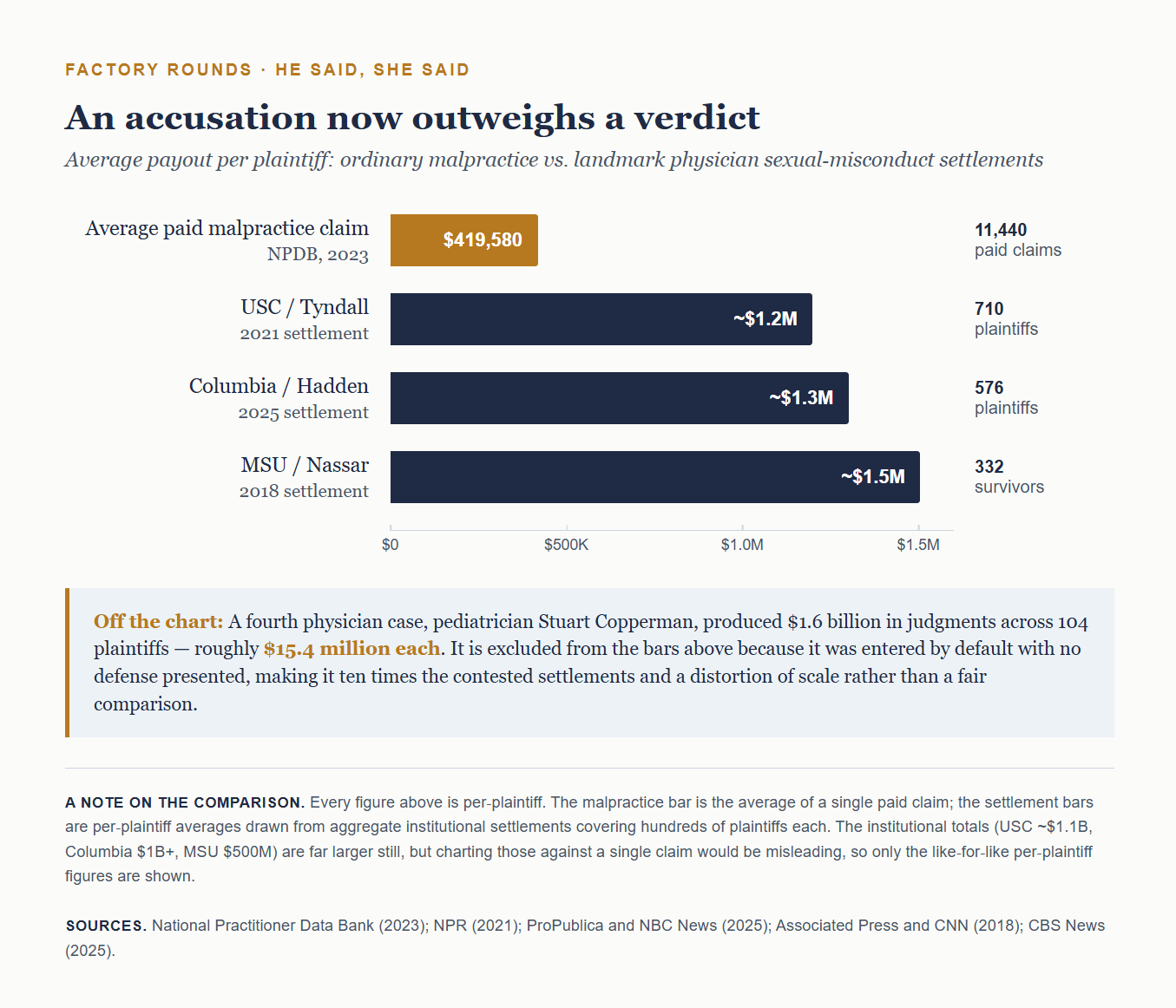
Consider the numbers. The National Practitioner Data Bank recorded approximately 11,440 paid medical-malpractice claims in 2023, with total payouts of $4.8 billion and an average payment per claim of $419,580.1 The Doctors Company reports that the average of the top fifty medical-malpractice verdicts in the country rose from $32 million in 2022 to $48 million in 2023 to $56 million in 2024, an escalation the industry attributes to what it calls social inflation.2 These are serious sums, and they reflect a tort system that has grown increasingly hostile to physicians and to the institutions that house them. They are also, however, dwarfed by the figures emerging from sexual-misconduct litigation.
The University of Southern California has paid more than $1.1 billion to resolve claims arising from the conduct of a single campus gynecologist, George Tyndall, including an $852 million settlement in 2021 covering 710 plaintiffs at an average of approximately $1.2 million each.3 Columbia University and NewYork-Presbyterian Hospital have now paid over $1 billion to former patients of Robert Hadden, including a $750 million settlement approved by a Manhattan court in May 2025 covering 576 plaintiffs at roughly $1.3 million per claimant.4 Michigan State University settled the claims arising from Larry Nassar’s conduct for $500 million covering 332 survivors, an average of approximately $1.5 million each, followed by an additional $380 million from USA Gymnastics and the U.S. Olympic Committee and $138.7 million from the Department of Justice for the FBI’s failures of investigation.5 By April 2025, judgments totaling $1.6 billion had been entered against a former Long Island pediatrician named Stuart Copperman in favor of 104 plaintiffs who had filed suit under New York’s Child Victims Act, with individual awards ranging from $500,000 to $32 million; Copperman presented no defense.6
The per-plaintiff figures, when laid against the average paid malpractice claim, are not merely larger. They exist in a different actuarial universe. A hospital that absorbs a malpractice verdict for the loss of an infant during a botched delivery may pay several million dollars. A hospital that absorbs a sexual-misconduct settlement for a single accusation by a single patient may pay roughly the same. But the malpractice case is one case, brought by one plaintiff, governed by a statute of limitations measured in years. The sexual-misconduct case is the first of what may be hundreds, brought under look-back statutes that have effectively abolished the statute of limitations, and aggregated into institutional exposures that no hospital balance sheet was ever designed to absorb.
New York’s Adult Survivors Act, signed by Governor Hochul in May 2022, opened a one-year window during which any plaintiff alleging adult sexual assault could sue regardless of when the alleged conduct occurred.7 By the time the window closed in November 2023, more than 3,000 suits had been filed, with hundreds naming New York City hospitals as institutional defendants.8 California, New Jersey, Colorado, Louisiana, and roughly two dozen other states have enacted analogous legislation. The doctrinal effect of these statutes has been to convert the institutional defendant into a permanent target, exposed to claims for conduct that may have occurred decades ago, involving accusers whose memories cannot be tested against contemporaneous evidence that no longer exists.
The specialty insurance market has noticed. Amwins, the wholesale broker, reported in 2024 that carriers in the medical-professional marketplace are “increasingly reducing or removing coverage for Sexual Misconduct Liability,” and that limits above $100,000 now require additional underwriting scrutiny that was, until recently, reserved for catastrophic exposures.9 The Medical Professional Liability Association observed in its 2025 industry analysis that the severity of sexual-misconduct cases dwarfs the verdicts and settlements of their medical-malpractice counterparts, and that while ordinary malpractice claim frequency has remained flat, multiple-claimant sexual-misconduct claims are growing.10 Beazley, the specialty insurer, has documented hospital sexual-misconduct settlements approaching $900 million for a single behavioral-health provider in 2024.11 The intentional-acts exclusion that typically governs professional-liability policies leaves the institution exposed under negligent-supervision and negligent-credentialing theories, which is precisely where the plaintiff’s bar has trained its fire.
The institutional response to this changed risk environment has been to develop a protocol for sexual-misconduct allegations that bears almost no resemblance to the protocol for malpractice claims. When a patient files a malpractice complaint, the accused physician typically continues working. The matter is referred to risk management and to counsel. Discovery proceeds. A settlement, if any, is negotiated quietly over months or years. The physician is not suspended. The physician’s livelihood is not interrupted. The National Practitioner Data Bank may eventually receive a report of the payment, but the physician’s career proceeds, and in many cases the physician never learns the final disposition of the matter until long after the dust has settled.
When the same patient, or any patient, files a sexual-misconduct allegation, the procedural posture flips. Under the federal Health Care Quality Improvement Act of 1986, hospitals enjoy peer-review immunity if they act on a reasonable belief that suspension furthers the quality of care, and the statute’s imminent-harm exception permits summary suspension without prior notice or hearing.12 A suspension exceeding thirty days triggers a mandatory report to the National Practitioner Data Bank, a permanent federal record that follows the physician across every credentialing application for the remainder of his career.13 The procedural protections that HCQIA notionally provides, including written notice, hearing, the right to counsel, and the right to cross-examine, attach only at the appeal stage, after the Medical Executive Committee has effectively decided the merits. By the time the physician obtains his hearing, the report has been filed, the suspension has run, and his marketability has been impaired beyond easy repair. The healthcare-defense bar has been unambiguous on this point: the common form of medical-staff bylaws creates a procedure in which the accused physician enjoys due-process rights only at a stage when they can be of little or no use.14
The institutional logic that produces this disparity is rational from the point of view of its leaders. The administrator running a modern hospital is not a physician and owes no professional fealty to the medical staff. His fiduciary obligation runs to the institution, and the institution’s exposure under a single substantiated sexual-misconduct claim, aggregated under joint-and-several liability with the other claims that may follow, is now an order of magnitude larger than its exposure under any plausible malpractice verdict. From the administrator’s vantage, the physician is a depreciating asset whose continued presence on the medical staff during an active allegation generates risk without offsetting return. Suspending him immediately, settling quietly if the allegation cannot be confidently disproven, and reporting to the federal databank within the thirty-day window are acts of prudent risk management, undertaken by people who understand precisely what they are doing and who answer to a board of directors that would terminate them for doing otherwise.
The settlement itself is the most insidious feature of the protocol. I have heard from colleagues, and the published investigative record confirms, that hospitals routinely resolve individual sexual-misconduct allegations for relatively modest sums, sometimes five or ten thousand dollars, sometimes more, on the rationale that the cost of litigating each allegation to a defense verdict exceeds the cost of paying it to go away. The 2016 Atlanta Journal-Constitution investigation, “License to Betray,” documented that hospitals and healthcare organizations “brush off accusations or quietly push doctors out,” frequently without reporting them to police or licensing agencies.15 It should be said plainly that the AJC's investigation is built on the opposite concern from my own. Its argument is that a permissive system allows genuinely abusive physicians to keep practicing for years before they are caught, and that hospitals' habit of disposing of complaints quietly serves to protect predators rather than expose them. I do not dispute that such cases exist, and the reporting documents them in harrowing detail. But the same institutional reflex the AJC condemns, the quiet payout and the quiet exit, operates with equal force against the innocent, and the newspaper's own pages contain physicians who told its reporters they felt targeted by patients hoping to profit from a lawsuit. A mechanism designed to make problems disappear does not pause to ask whether the problem was ever real.
One can sympathize with the administrator’s calculus and still recognize what it produces. A regime in which baseless complaints are routinely monetized is a regime that will generate more baseless complaints. The supply of accusations is responsive to the demand for them, and the demand has now been set by a settlement schedule that any reasonably motivated plaintiff can ascertain by reading a press release.
A critic will object, fairly, that genuine victims of physician sexual abuse have historically been silenced by precisely the institutional dynamics that I have been describing, and that the recent legal reforms represent a corrective overdue by decades. The look-back statutes did not appear from nowhere. They were a response to a documented reality in which institutions buried complaints, statutes of limitations expired before traumatized patients were ready to speak, and predators exploited both. A reform that lengthens the window in which a victim may seek redress is not, on its face, unjust. The difficulty is that the same reforms were calibrated almost entirely to the problem of the silenced victim and scarcely at all to the problem of the fabricated claim, as though the two could not coexist within the same system. They can, and they do. The doctrinal framework built to reach the genuine predator now processes the guilty and the innocent through identical machinery, and a system that draws no meaningful distinction between a substantiated allegation and an invented one will, with perfect predictability, produce the second-order effects that its architects appear never to have weighed.
The asymmetry in burdens of proof compounds the problem. Plaintiffs in civil sexual-misconduct cases must prove their claim only by a preponderance of the evidence, which is to say, more likely than not. Criminal cases require proof beyond a reasonable doubt, a burden that grand juries and prosecutors take seriously and that, in my colleague’s case, was not met. The civil case proceeds regardless. The Indiana Supreme Court and several other state high courts have now held that sexual misconduct alleged during an authorized medical examination falls within the scope of the state medical-malpractice statute, which provides plaintiffs access to professional-liability proceeds, broader negligent-credentialing theories against institutions, and in some states longer statutes of limitations than the underlying intentional tort would otherwise permit.16 The effect is to convert what would historically have been a difficult intentional-tort claim into a relatively straightforward malpractice claim with vastly deeper pockets.
The accused physician’s recourse is essentially theoretical. Statements made in the course of judicial or quasi-judicial proceedings, including complaints to state medical boards, are typically protected by absolute privilege. The accuser is further shielded by a category of law known as anti-SLAPP statutes, the acronym standing for strategic lawsuits against public participation. These laws, enacted in California, Oregon, and many other states, were designed to protect ordinary citizens from being silenced by retaliatory litigation, and they permit a defendant to have a suit dismissed early and to recover legal fees when the suit is construed as targeting protected speech. Their effect in this context is to make a defamation action by an accused physician not merely difficult but financially perilous, since a physician who sues an accuser and loses may be ordered to pay the accuser's legal costs. The appellate record is replete with such dismissals at the pleading stage.17
Malicious-prosecution claims require proof of malice and absence of probable cause, both of which are difficult to establish in a system that affords the accuser the presumption of good faith. Successful recoveries by exonerated physicians do exist, but they are vanishingly rare. The leading reported physician-defamation verdict, the $12 million award in Carlotti v. Petta, involved cosmetic-surgery complaints rather than sexual misconduct and was vacated by the Arizona Court of Appeals in 2015.18 More recently, in January 2025, a Pennsylvania chiropractor obtained a $1.1 million settlement in a federal malicious-prosecution action against a district attorney’s office and a complainant who had accused him of sexual assault, but the recovery required years of litigation, the cooperation of federal prosecutors, and a fact pattern in which the underlying criminal charges had been dropped.19 The asymmetry is plain. The accuser risks essentially nothing.
The human consequences of this regime are now becoming visible. Physician burnout, measured by the American Medical Association at 43.2 percent of physicians in 2024 and 41.9 percent in 2025, tracks with administrative burden, inadequate staffing, and a general sense that the institutional environment has become hostile to the practice of medicine.20 Among burned-out primary-care physicians, more than one-third reported in the Commonwealth Fund’s 2022 International Health Policy Survey that they planned to stop seeing patients within the following three years.21 The Association of American Medical Colleges has projected that the United States will face a shortage of between 86,000 and 124,000 physicians by 2036.22 Each of these data points is a separate measurement, but they describe the same phenomenon: the rational physician, weighing the risks of clinical practice against the alternatives, increasingly concludes that the alternatives are more attractive.
The alternatives are, in fact, attractive. The same intelligent young person who once would have chosen medicine can now choose investment banking, consulting, software engineering, or, most ironically, healthcare administration itself, and in each of those careers will earn comparable or superior compensation while remaining entirely shielded from the particular liability that I have been describing. A healthcare administrator who suspends a physician on the strength of an unsubstantiated allegation faces no professional risk. A physician suspended on the same allegation faces career annihilation. One does not need to be a free-market ideologue to predict the equilibrium that this asymmetry will produce, given enough time.
I am, as readers of this publication know, a free-market ideologue, and I want to be clear about what I am and am not proposing. I am not proposing additional federal regulation, additional mandatory training, additional credentialing requirements, or additional administrative machinery. The medical profession has been regulated to within an inch of its life, and each successive layer of regulation has produced not improved care but additional displacement of clinical judgment by bureaucratic process. I am proposing, rather, that the law restore symmetry where it has been lost, and that the natural consequences of false accusation be permitted to fall on those who make them.
Three reforms would accomplish most of what is needed. First, state legislatures should enact a clear civil cause of action, surviving anti-SLAPP, for physicians who have been formally cleared of sexual-misconduct allegations by a medical board or by a criminal proceeding, with a rebuttable presumption of damages and access to punitive damages where malice is shown. The standard should require demonstration of falsity by clear and convincing evidence and a wrongful purpose. This is restrictive enough to protect good-faith complainants while restoring some symmetry to the risk calculus. Second, hospitals should be permitted, and indeed should be expected, to dismiss from their practices any patient who has filed a complaint subsequently determined to be false. The physician-patient relationship is a voluntary association, and no other professional is required to continue serving a client who has defamed him. Third, joint-and-several liability in physician sexual-misconduct cases should be reformed in favor of several-only liability, which apportions damages to the actual culpable party and preserves institutional liability only for genuine negligent credentialing. None of these reforms would prevent a single legitimate victim from obtaining justice. All of them would diminish the supply of fabricated accusations.
The deeper problem, however, is structural and cannot be solved by tort reform alone. The modern hospital is not a guild of physicians. It is a corporation operated by administrators, accountable to a board that includes few practicing physicians, financed by capital markets that demand quarterly earnings, and embedded in a regulatory environment that has made the administrator’s job easier and the physician’s job harder in roughly equal measure for forty years. The administrator’s incentive to throw the accused physician overboard is not an accident. It is the predictable output of a corporate form that has displaced the older institutional logic in which physicians governed their own profession and the institutions in which they practiced.
That older logic was imperfect, and it permitted genuine predators to continue practicing for longer than they should have. I do not propose to restore it without modification. I do propose that we recognize what we have built in its place, which is an institutional form in which physicians bear all the risk of clinical encounter and administrators capture all the authority to manage that risk. The physician takes the liability; the administrator takes the revenue. The protocol that suspends my colleague within hours of an accusation is not a bug in that system. It is the system functioning exactly as it was designed to function. The question is whether enough physicians will recognize this in time to do anything about it, or whether they will simply, one by one and quietly, walk away from clinical practice and leave the wards to those who were never going to be in the room with a patient in the first place.
I suspect that most will walk away. I am not sure I blame them.
Miller and Zois. Medical malpractice statistics 2025. Available at: https://www.millerandzois.com/medical-malpractice/medical-malpractice-statistics/. Accessed May 27, 2026.
The Doctors Company. Inflation added $4 billion to medical malpractice losses, The Doctors Company study finds. September 8, 2025. Available at: https://www.thedoctors.com/about-the-doctors-company/newsroom/press-releases/2025/inflation-4b-malpractice-losses. Accessed May 27, 2026.
NPR. USC settlements top $1 billion to women who say George Tyndall abused them. March 25, 2021. Available at: https://www.npr.org/2021/03/25/981435791/usc-agrees-852-million-settlement-to-end-sex-abuse-litigation. Accessed May 27, 2026.
ProPublica. Columbia U will pay $750M to survivors of OB-GYN Robert Hadden. May 2025. Available at: https://www.propublica.org/article/columbia-university-750-million-settlement-robert-hadden-sexual-assault. Accessed May 27, 2026.
CNN. Larry Nassar settlement: Michigan State University settles with victims for $500 million. May 16, 2018. Available at: https://www.cnn.com/2018/05/16/us/larry-nassar-michigan-state-settlement. Accessed May 27, 2026. See also NBC News. Larry Nassar’s victims reach $138.7 million settlement over botched FBI probe. April 23, 2024. Available at: https://www.nbcnews.com/news/us-news/larry-nassars-victims-reach-1387-million-settlement-botched-fbi-probe-rcna148990. Accessed May 27, 2026.
CBS News. New York pediatrician accused of sex abuse ordered to pay $1.6 billion to 104 women. April 8, 2025. Available at: https://www.cbsnews.com/news/ny-pediatrician-stuart-copperman-accused-sex-abuse-ordered-pay-1-6-billion/. Accessed May 27, 2026.
New York State. Governor Hochul signs Adult Survivors Act. May 24, 2022. Available at: https://www.governor.ny.gov/news/governor-hochul-signs-adult-survivors-act. Accessed May 27, 2026.
Safe Horizon. Adult Survivors Act. Available at: https://www.safehorizon.org/adult-survivors-act. Accessed May 27, 2026. See also Hurwitz Fine PC. Adult Survivors Act look-back window closes while legislators signal efforts to reopen. Available at: https://www.hurwitzfine.com/blog/adult-survivors-act-look-back-window-closes-while-legislators-signal-efforts-to-reopen. Accessed May 27, 2026.
Amwins. Managing increasing sexual misconduct liability claims in healthcare. November 2024. Available at: https://www.amwins.com/resources-insights/article/managing-increasing-sexual-misconduct-liability-claims-in-healthcare. Accessed May 27, 2026.
MPL Association. Navigating extreme volatility: an underwriting analysis. Inside Medical Liability. Summer 2025. Available at: https://www.mplassociation.org/Web/Publications/Inside_Medical_Liability/Issues/2025/Summer/Navigating_Extreme_Volatility-An_Underwriting_Analysis.aspx. Accessed May 27, 2026.
Beazley. The growing risk of sexual misconduct liability in healthcare. Available at: https://www.beazley.com/en-001/articles/the-growing-risk-of-sexual-misconduct-liability-in-healthcare/. Accessed May 27, 2026.
Health Care Quality Improvement Act of 1986, 42 USC §§ 11101-11152. See also Athan Law. What is the Healthcare Quality Improvement Act? Available at: https://www.athan-law.com/practice-areas/liability/healthcare-quality-improvement-act. Accessed May 27, 2026.
Leichter Law Firm PC. Hospital peer review defense lawyer. Available at: https://www.leichterlaw.com/practice-areas/physician-license-defense/hospital-peer-review-defense/. Accessed May 27, 2026.
Liles Parker PLLC. HCQIA, due process and broken provider peer review system. September 3, 2014. Available at: https://www.lilesparker.com/2014/09/03/hcqia-due-process-fails/. Accessed May 27, 2026.
Atlanta Journal-Constitution. License to betray: a broken system forgives sexually abusive doctors in every state. July 2016. Available at: https://doctors.ajc.com/doctors_sex_abuse/. Accessed May 27, 2026.
Indiana Department of Insurance and Indiana Patient’s Compensation Fund v. Doe, Indiana Supreme Court, December 2024. Available at: https://caselaw.findlaw.com/court/in-supreme-court/116810966.html. Accessed May 27, 2026. See also Medical Justice. Can an alleged sexual assault be medical malpractice? Available at: https://medicaljustice.com/blog/alleged-sexual-assault-medical-malpractice/. Accessed May 27, 2026.
Public Participation Project. Oregon state anti-SLAPP. Available at: https://anti-slapp.org/oregon. Accessed May 27, 2026.
Medical Justice. When doctors sue patients: defamation is devastating, but a lawsuit could make it worse. Available at: https://medicaljustice.com/blog/when-doctors-sue-patients-defamation-is-devastating-but-a-lawsuit-could-make-it-worse/. Accessed May 27, 2026.
Times-Tribune. South Abington Township chiropractor wins $1.1 million settlement in false-arrest suit against Lackawanna County DA’s office. February 2025. Available at: https://www.yahoo.com/news/south-abington-twp-chiropractor-wins-010400943.html. Accessed May 27, 2026.
American Medical Association. Physician burnout rate continues to decline, falling to nearly 42%. Available at: https://www.ama-assn.org/practice-management/physician-health/physician-burnout-rate-continues-decline-falling-nearly-42. Accessed May 27, 2026.
Horstman C. A poor prognosis: more than one-third of burned-out U.S. primary care physicians plan to stop seeing patients. Commonwealth Fund. December 2024. Available at: https://www.commonwealthfund.org/blog/2024/poor-prognosis-more-one-third-burned-out-us-primary-care-physicians-plan-stop-seeing. Accessed May 27, 2026.
Association of American Medical Colleges. The complexities of physician supply and demand: projections from 2021 to 2036. March 2024. Available at: https://www.aamc.org/data-reports/workforce/data/complexities-physician-supply-and-demand-projections-2021-2036. Accessed May 27, 2026.