


The Centers for Disease Control and Prevention released its most recent autism prevalence data in April 2025. According to the CDC’s Autism and Developmental Disabilities Monitoring Network, 1 in 31 eight-year-old children in the United States now carries a diagnosis of autism spectrum disorder. In the year 2000, that figure was 1 in 150. Within a single generation, the diagnosed prevalence of autism has increased by more than 400 percent.1 A study published in JAMA Network Open documented a 175 percent increase in autism diagnoses among children and adults between 2011 and 2022 alone.2
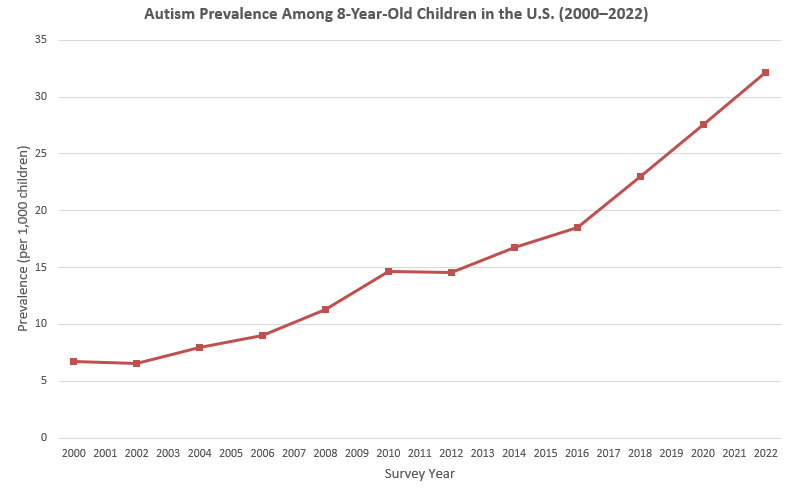
The medical establishment and advocacy community have largely greeted this trend with alarm and a call for more resources. Secretary of Health and Human Services Robert F. Kennedy Jr. declared an “autism epidemic.” Most researchers point to improved awareness, earlier screening, and expanded diagnostic criteria as the primary drivers of the increase. A minority argue that something environmental is genuinely making more children autistic. I want to make a different case: that the explosion in autism diagnoses is substantially the product of a progressive loosening of diagnostic standards, that this loosening has been encouraged and accelerated by a web of financial incentives operating at every level of the system, and that the consequences of this diagnostic inflation are serious for patients, for physicians, and for honest public discourse about children’s health.
Let me be clear about what I am not arguing. Severe autism is real, it is devastating, and the families who live with it deserve every support society can offer. I am not claiming that autism does not exist, that it has not increased at all, or that all children carrying the diagnosis are merely misbehaved. I am arguing that the diagnostic category has been stretched well past the point of clinical coherence, and that this stretching has been driven in no small part by forces that have little to do with medicine.
To understand how we arrived here, one must trace the evolution of the diagnostic criteria themselves. When the American Psychiatric Association published the third edition of the Diagnostic and Statistical Manual of Mental Disorders in 1980, autism was defined narrowly and severely: “lack of interest in people,” “severe impairments in communication,” and “bizarre responses to the environment.”3 This language described a profoundly impaired child. The diagnosis was rare because the condition it described was genuinely rare. The fourth edition, published in 1994, broadened the criteria substantially. “Severe impairments” became “qualitative impairments.” The concept of a spectrum was introduced, bringing in milder presentations including Asperger’s syndrome. Children who could communicate, who formed attachments, and who functioned at or near grade level could now qualify if they exhibited certain patterns of restricted interest or social awkwardness.4 The fifth edition, published in 2013, consolidated all subcategories into a single unified Autism Spectrum Disorder diagnosis and formally defined three severity levels. Level 3 corresponds roughly to what most people understood autism to mean historically: profound impairment requiring very substantial support. Level 1 requires only “support” for difficulties in social communication and flexible behavior. A child who becomes intensely absorbed in a narrow topic, who struggles with unstructured social situations, or who resists unexpected changes to routine can now qualify for a Level 1 diagnosis.5 The diagnostic language has shifted from concrete and observable to subjective and dimensional.
I speak with some personal authority on what a Level 1 diagnosis would have looked like in practice a generation ago. Growing up in the 1990s, I was a “geeky” kid with obsessive interests and hobbies, with hours spent on niche projects or memorizing obscure details. Making friends and fitting in didn’t come as naturally to me as it did to my peers. Fortunately, my schoolteachers saw these traits not as problems but as hallmarks of a “gifted” child. They placed me in a gifted program, where I met other intelligent, nerdy kids with their own unusual passions. Together, we thrived, achieving remarkable feats like winning international web design competitions and the National School Scrabble Tournament. I can’t help but suspect that had I been born just 25 or 30 years later, the same characteristics might have landed me a diagnosis of Level 1 autism instead of a spot in a gifted program. Rather than celebrating my strengths, today’s system might have placed me in special education. How differently would my life have gone, had that been the case? I doubt I would be a physician today. What’s more, how much damage would have been done to my developing psyche to be explicitly told that not only did my classmates think I was a little weird, but that all the adults thought so too -- so much so that they considered me to have a disease?
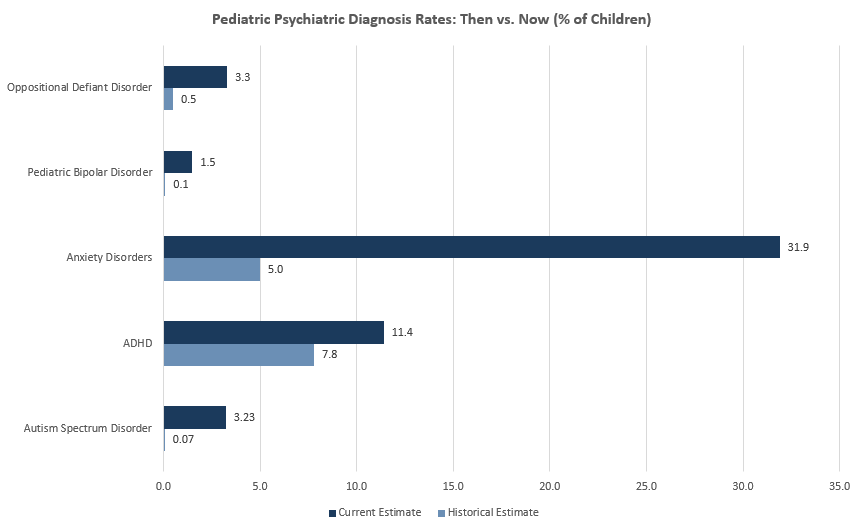
Autism is not the only psychiatric diagnosis that has undergone this kind of expansion. Attention Deficit Hyperactivity Disorder affected roughly 7.8 percent of American children in 2003; by 2022, that figure had risen to 11.4 percent.6 Pediatric bipolar disorder, nearly unrecognized before the 1990s, is now diagnosed in 1 to 2 percent of children.7 Anxiety disorders, once estimated to affect approximately 5 percent of children, now appear in surveys at rates exceeding 30 percent.8 Oppositional Defiant Disorder deserves particular scrutiny. The DSM-5 criteria for this diagnosis include “often loses temper,” “is often touchy or easily annoyed,” “often argues with adults,” and “often blames others for his mistakes.”9 These criteria must persist for at least six months and occur in the context of at least one relationship outside the sibling relationship. I would ask any parent of an adolescent whether they recognize this description. The fact that it constitutes a diagnosable psychiatric disorder is, at minimum, a serious question about where we have drawn the line between illness and ordinary human difficulty. The cumulative picture across these diagnoses is not one of a population growing sicker. It is one of a diagnostic enterprise that has progressively pathologized a wider range of human temperament, behavior, and development. The explanation that awareness has simply improved does not account for the magnitude and consistency of these increases across conditions, across age groups, and across nations.
There is a dimension of this problem that the medical literature rarely addresses directly: the question of who benefits financially from a diagnosis of autism, and how those incentives shape behavior at every level of the system. For families, particularly those in lower-income brackets, an autism diagnosis for a child unlocks a significant portfolio of public benefits. Through the Supplemental Security Income program, a qualifying child can provide the household with monthly federal payments; the current federal benefit rate is $994 per month for an individual.10 A diagnosis also typically establishes eligibility for Medicaid, which covers applied behavior analysis therapy, occupational therapy, speech therapy, and related services. Many states offer Medicaid waiver programs that expand eligibility beyond standard income limits and fund in-home support services. The Individuals with Disabilities Education Act guarantees a free and appropriate public education in the least restrictive environment, which in practice often means an Individualized Education Plan, supplemental aide services, and modified academic expectations.11 Autism diagnoses also qualify children for ABLE accounts, tax-advantaged savings vehicles, and for a range of state-specific grants and respite care programs.12 These programs exist to serve children with genuine and serious needs, but they create a powerful and largely unacknowledged incentive structure. When a diagnosis of autism transforms a child’s relationship to state and federal welfare systems, the decision to seek and accept that diagnosis is no longer a purely medical one.
I observe the downstream effects of this incentive structure daily in my practice as an emergency physician. Children arrive in the emergency department in behavioral crisis, and a review of their records reveals a constellation of psychiatric diagnoses accumulated over years: autism, ADHD, anxiety disorder, oppositional defiant disorder. What strikes me is not the presence of these labels but their apparent insufficiency as explanations. These children are often in genuine distress, but the distress frequently appears to track circumstances rather than neurology: a change in custody, an eviction, a parent’s absence, a household in chronic dysfunction. The psychiatric vocabulary has been applied to what looks, in the clinical encounter, more like a social crisis than a medical one. This observation is admittedly anecdotal, and I am cautious about drawing firm conclusions from emergency department presentations, which are by definition a selected and unrepresentative sample of children with these diagnoses. But it raises a question that the literature engages only reluctantly: to what extent does the diagnosis serve the child’s medical needs, and to what extent does it serve as the mechanism by which a family in distress gains access to services it would not otherwise receive? When the diagnosis is the key that unlocks a portfolio of benefits, families have every rational reason to seek it and clinicians have every professional reason to provide it. The child, in this transaction, functions less as a patient and more as a credential.
The incentives do not stop at the family level. School districts receive funding through IDEA that is tied to the number of students identified as having disabilities. Prior to 1999, federal IDEA grants were calculated directly from the count of students with disabilities, a formula that Congress itself recognized as creating incentives for over-identification and subsequently revised.13 The basic dynamic remains: more diagnosed students can mean more resources flowing to a district. For providers in states with generous Medicaid reimbursement for autism services, the financial incentives are more explicit still. Applied behavior analysis therapy is reimbursed at substantial rates, and the proliferation of autism treatment centers, assessment clinics, and early intervention providers represents a genuinely profitable industry that is entirely dependent on the continued supply of autism diagnoses.
The most dramatic illustration of how these incentives can metastasize involves the state of Minnesota, which has seen what federal prosecutors have described as a web of interlocking Medicaid fraud schemes amounting to, by some estimates, billions of dollars in fraudulent claims across multiple state programs.14 The autism component of this scandal centers on Minnesota’s Early Intensive Developmental and Behavioral Intervention program, which provides Medicaid-funded therapy to children diagnosed with autism spectrum disorder. Federal prosecutors charged the first defendant in this investigation in September 2025: Asha Farhan Hassan, who operated a clinic called Smart Therapy and was charged with wire fraud for her role in a $14 million scheme. According to the Department of Justice, Hassan and her partners actively recruited children from the Somali community to enroll in Smart Therapy, and when a recruited child did not already carry an autism diagnosis, they worked with a qualifying service professional to ensure the child obtained one. Court documents state that there was no child that Smart Therapy was not able to get qualified for autism services.15 Parents who enrolled their children received monthly cash kickbacks ranging from $300 to $1,500 per child. Smart Therapy’s employees included 18- and 19-year-olds with no relevant training or education.16
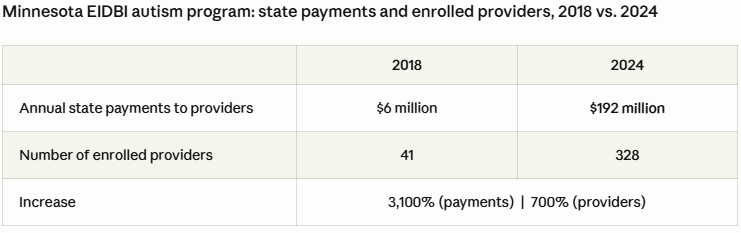
Hassan’s case was described by Acting United States Attorney Joseph H. Thompson as “not an isolated scheme.”17 The number of autism therapy providers in Minnesota grew from 41 in 2018 to 328 in 2024, a 700 percent increase. State payments for autism claims went from roughly $6 million in 2018 to nearly $192 million in 2024, and prosecutors believe the majority of that increase represents fraudulent billing.¹¹ A second defendant, the owner of a clinic called Star Autism Center, subsequently pleaded guilty to a parallel scheme.18 Of the 92 individuals charged across the various Minnesota fraud schemes as of late 2025, 82 are Somali American, a fact that has attracted considerable political attention.19
I do not think that the ethnic composition of the defendants is evidence of a cultural predisposition toward fraud. Rather, I believe it is a predictable consequence of exploiting social networks within a concentrated immigrant community. Fraud organizers approached parents in the Somali community because that community was large, concentrated in the Twin Cities, and already familiar with a social services infrastructure on which many members depended. The state’s own auditors have acknowledged that fear of being accused of racial discrimination made regulators reluctant to investigate complaints, allowing the fraud to grow for years before serious prosecution began.20 What the Minnesota scandal illustrates is not particular to the Somali community. It is a predictable consequence of a system in which the people disbursing money have no personal stake in whether it is spent honestly. A private insurer or charity must earn its revenue and answer to those who fund it; a government agency disburses tax dollars collected by compulsion and bears no meaningful cost when those dollars are stolen. The invitation to fraud was built into the program's architecture from the beginning, and it was accepted with enthusiasm. It was made orders of magnitude worse by a system which attached enormous financial rewards to a diagnosis that is inherently subjective and impossible to verify objectively.
That last point deserves emphasis. Autism spectrum disorder, particularly at Level 1 severity, has no biomarker, no blood test, no imaging finding. The diagnosis rests entirely on behavioral observation, clinical judgment, and parental report. This is not a criticism of clinicians who make the diagnosis honestly and carefully. It is an observation about the vulnerability of a subjective diagnostic standard to systematic abuse when significant sums of money are in play, and about the impossibility of auditing claims in any meaningful way when the underlying condition is defined behaviorally.
When the word “autism” described a child who was nonverbal, unable to form relationships, and incapable of independent living, it carried a weight that commanded a particular kind of social and institutional attention. When the same word describes a highly verbal, gainfully employed adult who identifies as autistic because he has narrow interests and finds small talk effortful, that weight is diminished. And when it is diminished, something else is lost as well: the urgency that attaches to serving people with severe and genuine impairments. The recent controversy over RFK Jr.’s characterization of autism as a severe disability prompted significant backlash from people who insisted their children, or they themselves, are “perfectly functional.” Some went further, arguing that autism is not a disease at all but a form of neurodiversity analogous to other dimensions of human variation. Whatever the philosophical merits of that position applied to high-functioning individuals, it would be strange indeed to apply it to a child who cannot speak, cannot dress himself, and cannot be left unsupervised. Both populations currently share a diagnostic label. That is a problem of taxonomy with real clinical and policy consequences.
Intellectual honesty requires engaging seriously with the most significant counterargument to the overdiagnosis thesis. The HHS press release accompanying the April 2025 CDC report noted that the proportion of children diagnosed with autism who have above-average IQ scores has decreased steadily over the past several reporting cycles, with nearly two-thirds of children in the 2022 survey classified as having at least borderline intellectual disability.21 If the rise in prevalence were driven purely by the addition of high-functioning, mildly affected individuals to the diagnostic category, one would expect the opposite trend. The counterargument, in its strongest form, is that we are finding genuinely disabled children who were previously missed.
This argument deserves a direct answer rather than a concession, because the intellectual disability data is considerably less straightforward than it appears. The most important factor is reclassification. Under the DSM-III and DSM-IV, autism and mental retardation were separate diagnoses assigned on separate diagnostic axes. A profoundly impaired child with low IQ and social deficits would typically receive a primary diagnosis of mental retardation, with autism either noted secondarily or not at all. Research published in the Journal of Medical Genetics found that 69 percent of individuals diagnosed with intellectual disability under prior criteria are likely to be recategorized and diagnosed with autism under current standards.22 The DSM-5 eliminated the multiaxial system entirely, making intellectual disability a co-occurring condition that sits alongside an autism diagnosis rather than competing with it. What this means in practice is that a substantial portion of today’s autism-plus-intellectual-disability population is almost certainly yesterday’s mental retardation population, carrying a new label without representing any new underlying pathology. The children did not change. The filing system did.
This interpretation is further supported by the historical trend in the comorbidity rate itself. In the 1980s, approximately 69 percent of individuals diagnosed with autism also carried a diagnosis of intellectual disability. By the mid-2010s, that figure had fallen to roughly 30 percent nationally, even as the raw number of autism diagnoses surged.23 The new cases being added to the autism rolls were overwhelmingly the milder, higher-functioning ones. The recent uptick in the intellectual disability comorbidity rate does not reverse this long-term trend so much as partially reflect the exhaustion of the high-functioning pool and the systematic incorporation of previously labeled intellectually disabled children into the autism category.
The Minnesota data on the Somali population adds a further complication that the counterargument cannot easily absorb. A 2025 University of Minnesota study found that 1 in 12 eight-year-old Somali children in the Twin Cities metro area carried an autism diagnosis, compared to 1 in 28 for the overall Minnesota population. Among Somali children with autism who had IQ test results in their records, 65 percent had intellectual disability, a rate substantially higher than the 37 percent observed in the overall Minnesota autism population.24 At first glance this appears to support the genuine-severity hypothesis. But 46 percent of Somali children with autism had no IQ test results in their records at all, leaving the true rate unknown. More importantly, this is precisely the population at the center of the Minnesota Medicaid fraud investigation, in which providers were recruiting Somali children indiscriminately, obtaining autism diagnoses for children who did not have them, and billing Medicaid for services that were never rendered. When fraud is the mechanism generating diagnoses in a specific community, the resulting prevalence data for that community cannot be taken at face value. The elevated intellectual disability rate among Somali children may reflect a genuine biological phenomenon, an artifact of language barriers and culturally inappropriate assessment instruments, the downstream effect of consanguineous marriage practices on neurodevelopmental outcomes, or simply the consequence of fraudulent diagnoses being assigned disproportionately to children who were already known to the system for other developmental concerns. The researchers themselves describe the finding as important and unexplained. It cannot do the work the counterargument would require it to do.
Some readers will note that population-level IQ data for Somalia have been cited in certain quarters as a partial explanation for the elevated intellectual disability rates among Somali children with autism in Minnesota; the evidence underlying those figures is methodologically thin, heavily disputed in the peer-reviewed literature, and in any case confounded by the profound effects of war, famine, educational deprivation, and the documented cognitive consequences of vitamin D deficiency during pregnancy in a population that relocated from an equatorial climate to the upper Midwest.
The honest summary is this: the rise in autism diagnoses among children with intellectual disability is substantially explained by the reclassification of children who were previously diagnosed with mental retardation under an older diagnostic framework. The remaining increase reflects a genuine mix of improved identification of severely affected children who were historically overlooked, diagnostic expansion into populations previously served under different labels, and in some communities, outright fraud. None of this requires us to conclude that the underlying prevalence of severe, biologically grounded autism has increased at anything approaching the rate the raw numbers suggest.
The physician who diagnoses a child with autism in the current system faces almost no professional cost for doing so and potentially avoids significant friction. A diagnosis can be documented quickly, it satisfies the family’s desire for an explanation, it connects the child to services, and it insulates the clinician from criticism that he failed to identify a condition. Declining to diagnose, or recommending watchful waiting, requires time, sustained explanation, and tolerance for uncertainty. The incentive structure runs entirely in one direction. A health care system organized on genuine free market principles would introduce countervailing pressures. When private insurers bear the cost of services associated with a diagnosis, they have a direct financial interest in ensuring that diagnoses are applied accurately and that claimed services are actually rendered. When the state is the payer, as it is for the tens of millions of children enrolled in Medicaid, no such countervailing interest exists. The payer does not negotiate, does not question, and does not bear the cost of diagnostic error in the way a financially accountable private insurer would. The explosion of Minnesota’s autism provider rolls from 41 to 328 in five years would have triggered scrutiny far earlier in a system where someone stood to lose money by paying fraudulent claims, rather than a system in which the money being paid belonged to no one in particular and to everyone in general.
Children with genuine, profound autism deserve accurate diagnosis, sustained support, and serious medical attention. Children who are shy, intense, easily frustrated, or socially awkward deserve patient adults, appropriate challenge, and the benefit of the doubt that their struggles fall within the ordinary range of human variation. Conflating these two groups does not serve either one. It burdens genuinely normal children with a medicalized identity, diverts resources from those who most need them, and creates the conditions under which a $192 million fraud can grow quietly in plain sight for six years before anyone investigates. The willingness to say so plainly is not cruelty toward disabled children. It is the precondition for actually serving them.
Shaw KA, Williams S, Patrick ME, et al. Prevalence and early identification of autism spectrum disorder among children aged 4 and 8 years — Autism and Developmental Disabilities Monitoring Network, 16 sites, United States, 2022. MMWR Surveill Summ. 2025;74(SS-2):1–22.
Grosvenor LP, Croen LA, Lynch FL, et al. Autism diagnosis among US children and adults, 2011–2022. JAMA Netw Open. 2023;6(11):e2340544.
American Psychiatric Association. Diagnostic and Statistical Manual of Mental Disorders. 3rd ed. 1980.
American Psychiatric Association. Diagnostic and Statistical Manual of Mental Disorders. 4th ed. 1994.
American Psychiatric Association. Diagnostic and Statistical Manual of Mental Disorders. 5th ed. 2013.
Danielson ML, Claussen AH, Bitsko RH, et al. ADHD prevalence among U.S. children and adolescents in 2022. J Clin Child Adolesc Psychol. 2024;53(3):343–360.
Van Meter AR, Moreira AL, Youngstrom EA. Meta-analysis of epidemiologic studies of pediatric bipolar disorder. J Clin Psychiatry. 2011;72(9):1250–1256.
Rapee RM, Creswell C, Kendall PC, Pine DS, Waters AM. Anxiety disorders in children and adolescents: a summary and overview of the literature. Behav Res Ther. 2023;168:104376. doi:10.1016/j.brat.2023.104376
National Institute of Mental Health. Any anxiety disorder. Updated 2024. Accessed April 21, 2025. https://www.nimh.nih.gov/health/statistics/any-anxiety-disorder.shtml
American Psychiatric Association. Diagnostic and Statistical Manual of Mental Disorders. 5th ed. 2013.
Social Security Administration. Supplemental Security Income (SSI) benefits. Social Security Administration website. Accessed May 17, 2026. https://www.ssa.gov/ssi/text-benefits-ussi.htm
Education Week. How special education funding actually works. April 2023. https://www.edweek.org/teaching-learning/how-special-education-funding-actually-works/2023/04
Social Security Administration. Spotlight on achieving a better life experience (ABLE) accounts. Social Security Administration website. Accessed May 17, 2026. https://www.ssa.gov/ssi/spotlights/spot-able.html
Autism Speaks. Financial assistance resources. Autism Speaks website. Accessed May 17, 2026. https://www.autismspeaks.org/financial-autism-support
Education Week. How special education funding actually works. April 2023. https://www.edweek.org/teaching-learning/how-special-education-funding-actually-works/2023/04
Wikipedia. 2020s Minnesota fraud scandals. https://en.wikipedia.org/wiki/2020s_Minnesota_fraud_scandals
U.S. Department of Justice / IRS Criminal Investigation. First defendant charged in autism fraud scheme. September 24, 2025. https://www.irs.gov/compliance/criminal-investigation/first-defendant-charged-in-autism-fraud-scheme
U.S. Department of Justice / IRS Criminal Investigation. First defendant charged in autism fraud scheme. September 24, 2025. https://www.irs.gov/compliance/criminal-investigation/first-defendant-charged-in-autism-fraud-scheme
Minnesota Reformer. U.S. Attorney: Fraud likely exceeds $9 billion in Minnesota-run Medicaid services. December 18, 2025. https://minnesotareformer.com/2025/12/18/u-s-attorney-fraud-likely-exceeds-9-billion-in-minnesota-run-medicaid-services/
CBS Minnesota. Owner of Minnesota autism center pleads guilty in fraud scheme. March 2026. https://www.cbsnews.com/minnesota/news/minnesota-autism-center-guilty-plea/
FOX 9 Minneapolis-St. Paul. Fraud in Minnesota: Detailing the nearly $1 billion in schemes. December 2025. https://www.fox9.com/news/fraud-minnesota-detailing-nearly-1-billion-schemes
CBS Minnesota. Owner of Minnesota autism center pleads guilty in fraud scheme. March 2026. https://www.cbsnews.com/minnesota/news/minnesota-autism-center-guilty-plea/
HHS Press Office. Autism epidemic runs rampant: new data shows 1 in 31. April 15, 2025. https://www.hhs.gov/press-room/autism-epidemic-runs-rampant-new-data-shows-grants.html
Jensen M, Smolen C, Girirajan S. Gene discoveries in autism are biased towards comorbidity with intellectual disability. J Med Genet. 2020;57(9):647–652. doi:10.1136/jmedgenet-2019-106476.
The Transmitter: Neuroscience News and Perspectives. The blurred line between autism and intellectual disability. Accessed May 17, 2026. https://www.thetransmitter.org/spectrum/the-blurred-line-between-autism-and-intellectual-disability/
Minnesota Autism and Developmental Disabilities Monitoring Network (MN-ADDM), University of Minnesota. Press briefing: September 26, 2025. Accessed May 17, 2026. https://addm.umn.edu/detailed-findings/press-briefing-2025-09-26